Inland Empire Warehouse Market Report: Q1 2026

Amanda Hendrick
Staff Researcher
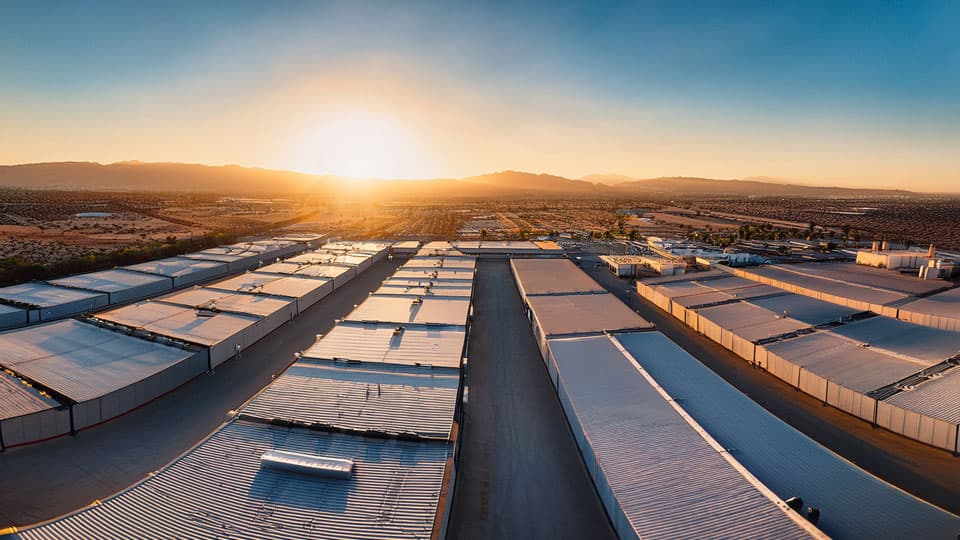
The Inland Empire remains one of North America’s most important logistics hubs, supported by its proximity to the Ports of Los Angeles and Long Beach and a vast regional distribution network. After a record construction wave, the market entered 2026 in a recalibration phase marked by elevated vacancy, softer rents, and a sharply reduced development pipeline. While deliveries recently outpaced absorption, leasing activity remains strong by national standards, and long-term fundamentals continue to be driven by e-commerce demand, port throughput, and the region’s deep transportation workforce.
Introduction and scope
The Inland Empire remains one of the most strategically important industrial logistics markets in North America, functioning as an “inland port” for freight flows originating at the and and moving through Southern California’s regional distribution networks. In 2025, the Port of Los Angeles reported ~10.24 million total TEUs and ~5.32 million loaded-import TEUs for the calendar year, while the Port of Long Beach reported ~9.88 million TEUs handled in 2025, underscoring the sustained scale of gateway-driven goods movement that ultimately feeds Inland Empire warehouse demand.
This report focuses specifically on industrial and warehouse properties across the Inland Empire, including Riverside County and San Bernardino County and commonly referenced submarket groupings (East, West, North, and High Desert). Results reflect the most recent “complete quarter” datasets available as of March 2026, which are primarily Q4 2025 market reports released in January–February 2026, supplemented with early-2026 macro indicators (ports, rates, labor).
Important note on comparability: major research platforms sometimes differ in market boundaries, building inclusion criteria, timing of lease “credit,” and treatment of renewals/sublease. As a result, this report often presents ranges when multiple reputable sources diverge.
Market overview and current conditions
By late 2025, Inland Empire industrial conditions shifted decisively away from the post-pandemic landlord-favorable peak. Across most datasets, the market is characterized by elevated vacancy and availability, declining/softening asking and taking rents, and a meaningfully reduced construction pipeline, setting the stage for a gradual rebalancing if demand remains steady.
Market size and headline metrics (Q4 2025, select sources):
- Inventory scale: one major dataset places Inland Empire total industrial inventory at ~700.3M SF.
- Vacancy rate: reported ~7% to ~9%+, depending on source and geography:
- 7.3% (market-wide measure in one dataset).
- 8.1% (another market-wide estimate).
- 7.6% (separate estimate citing modest QoQ increase).
- 9.4% (separate estimate, still rising).
- Availability rate (total): broadly clustered around the low double digits:
- 11.4% (market-wide).
- 11.7% (market-wide availability reaching a multi-year high in several reports).
- Rent levels (NNN, per SF per month):
- Taking lease rate ~$1.03 NNN in the core “East/West” definition (a common benchmark cited by multiple reports).
- Direct asking rent ~$1.13 NNN (market-wide), with sublease ~ $0.92 pulling blended averages lower.
Market narrative in one line: vacancy and availability rose because deliveries exceeded absorption, while rent growth turned negative and landlord concessions became more common as landlords competed to fill space.
Supply, demand, and development pipeline
Development volume moderated substantially from the 2021–2022 peak, reflecting higher financing costs, larger blocks of available space, and more cautious underwriting. Several research teams describe this as the pipeline “emptying” phase—new deliveries are still arriving, but starts are down sharply, which should reduce incremental supply pressure through 2026 if sustained.
Construction and deliveries (recent levels):
- Under construction:
- ~2.4M SF under construction in the core (East/West) definition in Q4 2025 (described as the lowest point in ~15 years in that series).
- ~2.8M SF under construction in another market-wide dataset (15 projects), with “few new starts anticipated” in 2026.
- ~7.5M SF under construction in a broader market definition, described as the lowest since 2013, with only ~3.9M SF speculative (supporting a more supply-disciplined outlook).
- Deliveries:
- One dataset cites ~12.7M SF delivered (completed) during 2025.
- Another cites ~14.9M SF of deliveries versus ~5.7M SF net absorption for the year (highlighting the supply-demand imbalance).
- For Q4 alone, reported deliveries vary by definition (examples include ~2.6M SF and ~4.0M SF).
Pipeline quality and preleasing:
- One dataset reported that ~79% of Q4 deliveries in the core delivered vacant (4.2M SF vacant out of 5.3M SF delivered), which has been a key driver of rising vacancy.
- Conversely, within a broader construction set, ~48.1% of under-construction space was pre-leased, attributed to a small number of very large commitments—an important offset that can reduce the “true speculative” risk as projects deliver.
Submarket supply dynamics (directional takeaways):
- Core submarkets (often associated with major logistics corridors) continue to receive large-format deliveries, including projects in and that delivered with meaningful vacant inventory in late 2025.
- North/High Desert activity is increasingly shaped by a combination of large-format projects and a distinct regulatory environment; one report specifically flags future absorption tied to major facilities in and .
Vacancy, availability, and pricing trends
Comparative submarket snapshot
The table below consolidates Q4 2025 submarket metrics from one major dataset to support side-by-side comparison of East, West, and North/High Desert (as defined by that provider), plus market totals.
| Submarket (provider-defined) | Inventory (SF) | Vacancy (%) | Availability (%) | Q4 Net Absorption (SF) | Q4 Gross Activity (SF) | Under Construction (SF) | Avg. Taking Lease Rate ($/SF/mo/NNN) |
|---|---|---|---|---|---|---|---|
| East | 314,286,883 | 8.5 | 11.9 | 1,345,009 | 4,781,230 | 729,862 | 0.93 |
| West | 361,144,959 | 6.0 | 10.8 | (1,636,384) | 5,298,619 | 1,659,169 | 1.12 |
| North / High Desert* | 24,895,312 | 12.8 | 14.4 | (791,035) | 102,730 | 4,213,273 | 0.00** |
| Inland Empire Total | 700,327,154 | 7.3 | 11.4 | (1,082,410) | 10,182,579 | 6,602,304 | 1.03 |
* “North / High Desert” labeling reflects common market vernacular; the underlying row is “Inland Empire North” in the source table.
** The source table lists $0.00 for the North taking lease rate, which typically indicates no meaningful comparable “taking rate” observations captured for that submarket in the quarter (rather than an actual economic rent of zero).
Vacancy and availability profile
Across sources, the “headline” shift is that vacancy climbed into a range that is widely interpreted as tenant-favorable in a market that previously operated near scarcity conditions.
- Vacancy distribution:
- Market-wide vacancy commonly printed between the high 7% and low 8% range in multiple reports, while some reported closer to ~9%+.
- North/High Desert (provider-defined) showed substantially higher vacancy (~12.8%) in the referenced dataset.
- Availability (total):
- Availability was commonly reported around ~11.4%–11.7%, with some characterization as a multi-year high.
- Sublease space (scale and share):
- One report: ~14.6M SF of sublease availability (down ~0.6M SF QoQ), representing ~18.9% of total availability.
- Another report: sublease availability of ~16.1M SF in Q4 2025 (down from ~16.8M SF in Q3 2025).
- Another report: ~17.4M SF of available sublease space, representing ~20.6% of all available space.
Asking rents, taking rents, and concessions
A key theme across multiple reports is that quoted rents are softening, and effective rents may be further discounted by concessions.
- Taking lease rates (signed deals):
- Core benchmark taking lease rates were cited around $1.03 NNN per SF per month, with East lower (~$0.93) and West higher (~$1.12) in one dataset.
- Asking rents (marketing):
- Direct asking rents averaged ~$1.13 NNN market-wide, down both quarter-over-quarter and year-over-year in one major report; sublease asking averaged ~$0.92, pulling the blended average lower.
- Concessions and deal structure:
- Reports describe landlords becoming more flexible as elevated availability increased competition, supporting tenant leverage in negotiations.
Leasing activity, absorption, and notable transactions
Leasing volume and absorption
Despite the weaker pricing environment, the Inland Empire remains an exceptionally active leasing market by national standards; however, the timing mismatch between new supply delivery and move-ins remains the primary driver of softer occupancy metrics.
Leasing activity (selected indicators):
- One report recorded ~9.0M SF of new leasing activity in Q4 2025 (96 deals), and ~42.1M SF for full-year 2025, down modestly year-over-year.
- Another reported ~9.7M SF of Q4 transactions, with year-to-date gross activity ~45.8M SF.
- A core-only lens reported ~9.5M SF of Q4 new leasing in the East/West core, with approximately ~9.6% of that quarter’s leasing activity attributed to subleases.
Net absorption (why numbers diverge):
- Several credible sources disagreed on Q4 absorption direction and magnitude, reflecting differences in move-in timing capture and market definitions:
- A market-wide view reported ~1.5M SF negative absorption in Q4 2025, after strong positive absorption in Q3.
- A core-only view cited ~(291,000) SF net absorption in Q4 2025, while the broader market ended with ~(1.08M SF) net absorption.
- Another report emphasized a strong Q4 move-in wave, reporting ~3.1M SF positive net absorption in Q4 2025 and ~5.7M SF for full-year 2025.
Product-type and size-segment demand:
- Large-format, modern warehouses continue to attract demand even as availability rises—reflected in Class A leasing comprising ~60.6% of total leasing activity in 2025, above the historical average in that dataset.
Notable leases and move-ins
Select major leases and move-ins reported in late 2025 include:
- ~754K SF renewal at 10825 Production Ave (reported with West-submarket label in one lease table).
- ~657K SF new lease at 4323 Indian Ave in .
- ~657K SF new lease at 11850 Riverside Dr in .
- ~652K SF new lease at 17820 Slover Ave in .
- ~593K SF renewal at 701 S Arrowhead Ave in San Bernardino.
- ~855K SF move-in at 3690 Webster Ave (noted as a driver of strong Q4 absorption in one report).
- ~844K SF move-in at 5690 Industrial Pkwy (noted as a driver of strong Q4 absorption).
- ~828K SF move-in (also cited as the quarter’s largest move-in by another source).
Notable move-out pressure (North/High Desert): in addition to wider-market givebacks, one report highlights a large move-out by in , contributing to weakness in the North/High Desert area.
Sales and investment activity
Capital markets activity has been shaped by the combination of (1) higher debt costs versus the early-2020s environment, (2) a reset in rent growth expectations, and (3) selective investor appetite for newer, well-located logistics assets.
Transaction volume and pricing
A data provider update dated December 2025 characterized 2025 as another “lower-volume” year relative to the prior cycle peak:
- Total sales volume: approximately $2.6B in 2025, down from a ~$7.8B peak year (2021) cited by the same source.
- Deal count: fewer than 400 sale transactions closed for a second consecutive year in that dataset.
- Pricing and vacancy at sale (past 12 months):
- 397 sale comparables
- Average cap rate ~5.6%
- Average price/SF ~$236
- Average vacancy at sale ~16.2%
Cap rates and yield environment
- The same dataset states that cap rates on logistics building sales over $10M increased by roughly ~150 bps from the 2021–2022 period to the mid-5% range, consistent with broader rate-driven repricing.
- A cap-rate trend graphic in that source shows an Inland Empire series clustering materially below the broader U.S. series (reflecting the market’s historic liquidity and institutional focus), but with gradual upward movement from the 2021–2022 trough.
Notable recent deals
Examples of notable sales and pricing signals cited in late 2025 include:
- A large single-asset transaction in : 41995 Remington Ave sold for
$10.5M ($175/SF) at a ~5.9% cap rate (fully leased at sale, with in-place rents reportedly below market). - A significant Q4 2025 sales list includes a transaction at 10681 Production Ave with reported pricing of
$174M ($158/SF). - One dataset also flagged elevated owner-user activity and a concentration in smaller building size segments for user purchases in the core market, suggesting occupiers continued to pursue strategic control where feasible.
Drivers, challenges, opportunities, and outlook
Key economic and market drivers
Industrial demand in the Inland Empire is anchored by a blend of gateway trade, domestic consumption, and supply-chain restructuring. The most cited drivers in recent research include:
- Port-gateway throughput and volatility
- The Ports of Los Angeles and Long Beach reported extremely large 2025 volumes (10.24M TEUs and 9.88M TEUs, respectively).
- The Port of Los Angeles also notes that, when combined with Long Beach, the San Pedro Bay port complex handled roughly ~31% of U.S. containerized international waterborne trade in 2024 (a structural indicator of the gateway’s enduring significance).
- Trade policy uncertainty (tariffs) was explicitly cited by multiple market reports as a factor contributing to delayed leasing decisions and uneven port/import patterns.
- E-commerce and retail demand
- The reported that e-commerce represented ~15.8% of total retail sales in Q3 2025 (seasonally adjusted e-commerce sales of ~$310B on total retail sales of ~$1.89T), supporting continued structural demand for distribution space even as growth normalizes.
- Transportation/warehousing employment base
- The Riverside–San Bernardino–Ontario metro recorded ~213.8K employees in transportation and warehousing (not seasonally adjusted) as of Dec 2025, highlighting the region’s deep logistics labor pool.
- Interest rates and financing conditions
- The maintained the federal funds target range at 3.5%–3.75% at its January 2026 meeting, and the upper limit was shown at 3.75% as of March 1, 2026 in a widely used reference series.
- The 10-year Treasury yield (a common CRE financing benchmark) was around ~4.0% in late February 2026 in the referenced data series.
- Environmental and land-use regulation influencing site selection
- The describes its WAIRE program (Rule 2305) as an indirect source rule regulating warehouses (≥100,000 SF in a single building) to reduce goods-movement emissions.
- State-level logistics siting and design standards (AB 98) were set to begin January 1, 2026 for new or expanded logistics developments (as described in the official bill summary), which market participants expect to influence where new supply can most easily be entitled.
Challenges and opportunities
Challenges being priced into the market:
- Elevated vacancy/availability and a larger pool of big-box options, giving tenants leverage.
- Rent softening and “reset” expectations versus the 2022–2023 peak cycle.
- Ongoing trade/tariff uncertainty affecting inventory strategy, import timing, and leasing decision cycles.
- Higher cost of capital and cap-rate repricing constraining transaction velocity and compressing development feasibility.
Opportunities emerging in a tenant-favorable environment:
- Tenants can pursue “flight-to-quality” upgrades into newer high-clear logistics space while landlords compete on economics.
- The sharp pullback in starts reduces forward supply risk; multiple reports anticipate that constrained new starts could help re-balance conditions over the next 12–18 months if demand stabilizes.
- Investors may find entry points through repriced assets and higher going-in yields (mid-5% cap rate averages in certain datasets), though underwriting remains sensitive to lease-up risk and effective rent trends.
Outlook for 2026 and beyond
The consensus across late-2025 research is not “boom” or “bust,” but gradual normalization—a market working through excess supply from the prior cycle while benefiting from structural logistics demand.
Base case (most likely): gradual stabilization through 2026
- With development starts muted and under-construction volume at cycle lows in several datasets, supply growth is expected to moderate, improving the probability that vacancy peaks and then slowly declines as leasing catches up.
- One report explicitly projects that supply and demand should come into balance over the next ~18 months if subdued construction persists.
- Another identifies potential for stabilization/tightening by late 2026 in parts of the market if demand rebounds and the construction pipeline remains constrained.
Upside scenario (faster tightening):
- Continued high port throughput and resilient consumption could support renewed absorption, particularly for modern big-box facilities, while a low speculative pipeline limits new competitive supply.
- If interest rates decline further from early-2026 levels, both leasing confidence and investment liquidity could improve.
Downside scenario (prolonged softness):
- A sharper trade-driven slowdown (e.g., tariff shocks and retaliatory actions) could reduce import volumes and delay occupier decisions, extending vacancy normalization and keeping effective rents under pressure.
- Elevated market-wide availability and sublease space (high-teens MSF across multiple sources) increases competitive options for tenants and can cap near-term rent growth.
Overall, as of March 2026, the Inland Empire industrial market appears to be in the middle innings of a cycle reset: vacancy and availability are elevated (often ~7%–9% vacancy and ~11%–12% availability depending on definition), rents are softer (with common benchmarks near ~$1.00–$1.03/SF/mo on an NNN basis in core metrics), and the development pipeline is sharply reduced—conditions that typically precede stabilization once leasing volume and move-ins catch up to the delivered supply.